

Budget Season Is Coming — And SMEs Are at the Heart of It
Every year, the Union Budget feels like results day for business owners.
What changes?
What becomes costlier?
Which industries benefit?
Which policies tighten?
For SMEs across Tamil Nadu, Kerala, Karnataka, Telangana, and Andhra Pradesh, Budget 2025 will shape profit margins, cash flow, taxation, and future planning.
But Budget summaries online are usually full of jargon, confusing charts, and numbers that don’t feel relevant to everyday business.
So in this blog, we break it down in a simple, practical way — what South Indian SMEs should realistically expect and prepare for in Budget 2025.
1. Possible Tax Relief for Small Businesses
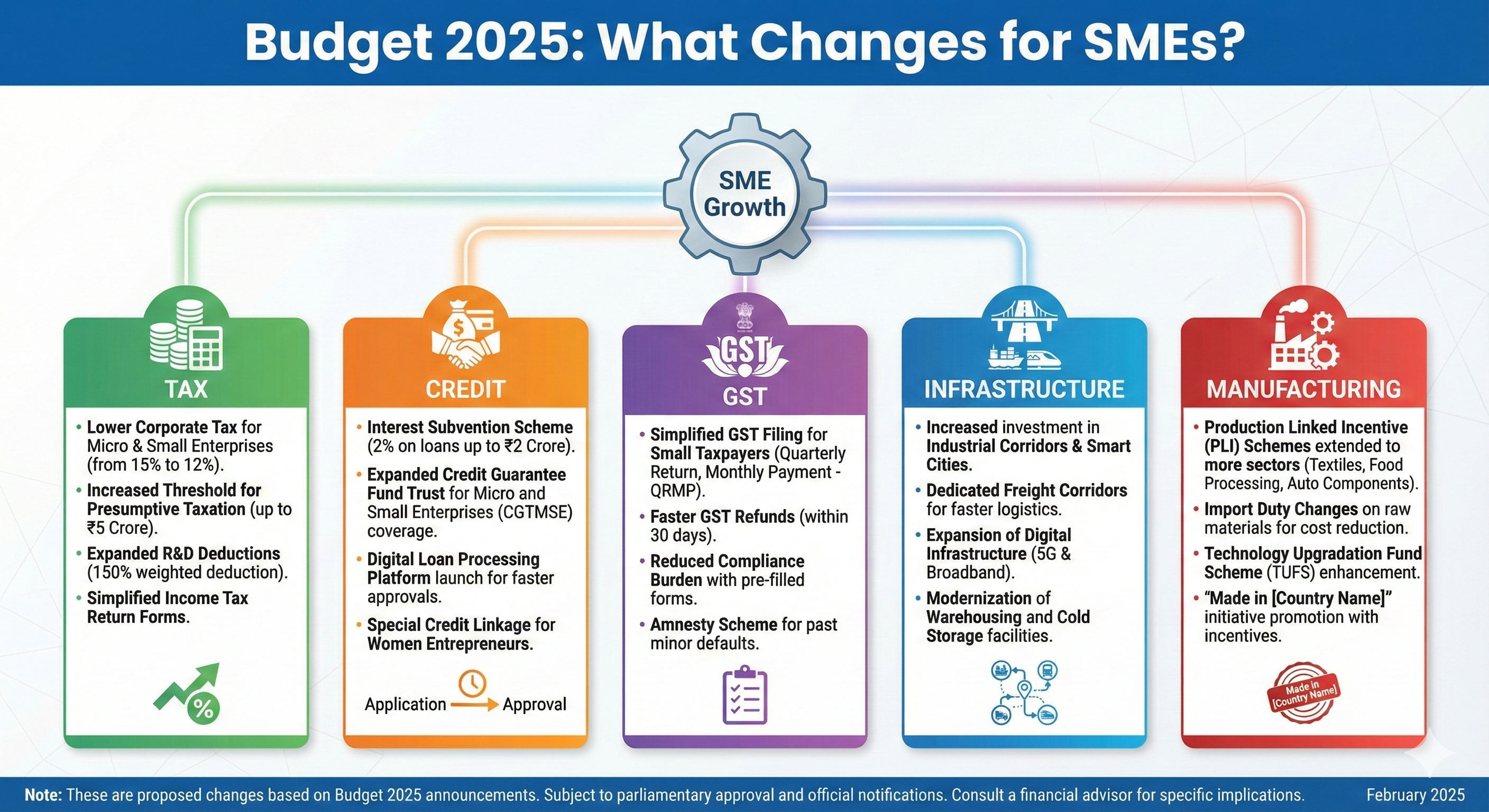
SMEs have been demanding a simpler and lighter tax structure — especially after facing high input costs, delayed payments, and rising compliance burdens.
Key areas likely to see changes:
A) Higher Turnover Limit for Lower Corporate Tax Bracket
Currently, MSMEs with turnover up to ₹400 crore enjoy a 25% corporate tax rate.
Experts expect the limit to rise to ₹500–600 crore to support scaling companies.
B) Simplified Presumptive Tax for Small Traders
South India’s trading hubs — Chennai, Coimbatore, Madurai, Kochi, Bengaluru KR Market, Hyderabad Begum Bazaar — rely heavily on presumptive tax.
Expect:
Higher turnover limit (currently ₹2 crore)
Possibly reduced documentation requirements
C) Better Input Tax Credit (ITC) Clarity
Industries like textiles, construction materials, electronics, and FMCG distribution face ITC blockages.
Budget 2025 may bring:
Faster ITC refunds
Relaxed reconciliation timelines
Clear rules for mismatched GSTR details
Why it matters for SMEs:
More liquidity. More working capital. Fewer disputes.
2. Major Push for Manufacturing in South India
Tamil Nadu, Karnataka, and Telangana are now India’s manufacturing big 3 outside of Maharashtra–Gujarat.
Budget 2025 is expected to boost:
EV manufacturing
Electronics clusters
Precision engineering
Defence manufacturing
Textile value-chain modernization
What SMEs should watch:
Higher incentives under PLI schemes
Lower import duties for key components
New industrial park allocations
Export-linked benefits for MSMEs
Reduced GST on manufacturing supplies
If you’re in auto components, textiles, electrical goods, machinery, chemicals, or printing, this section will directly impact pricing and profitability.
3. Credit Access Reforms — Liquidity Will Become Easier
This is the area SMEs care about the most.
For years, SMEs have struggled with:
Delayed loan approvals
Heavy collateral requirements
High credit score dependency
Banks rejecting because of “insufficient vintage”
But Budget 2025 is expected to push credit flow aggressively.
Possible measures:
A) Faster Approval Timelines for MSME Loans
Banks may be mandated to meet timelines for:
Working capital
Machinery loans
Invoice financing
B) CGTMSE Expansion
Government-backed credit guarantee schemes may now cover:
Higher ticket sizes
More industries
More flexible terms
C) Special Fund for South Indian Manufacturing MSMEs
Tamil Nadu, Telangana, and Karnataka are lobbying for a dedicated fund for SMEs supplying to EV, aerospace, defence, and electronics clusters.
D) Digitised Credit Flow
Expect more support for:
GST-linked lending
Bank-statement-based underwriting
Digital invoice discounting
Why this matters:
Businesses won’t be stuck for 3–4 weeks waiting for approvals, giving alternates like Sunrays Finance a bigger role during urgent requirements.
4. Infrastructure Upgrades That Directly Impact SMEs
South India is witnessing a massive infrastructure boom.
Budget 2025 will accelerate projects in:
Tamil Nadu
Chennai Peripheral Ring Road
Coimbatore–Bengaluru Industrial Corridor
Tuticorin Port expansion
New textile parks (Erode, Virudhunagar)
Karnataka
Industrial nodes around Tumkur
Bengaluru suburban rail
New logistics parks
Telangana
Pharma City
Electronics manufacturing clusters
Outer Ring Road upgrade
Andhra Pradesh
Visakhapatnam IT investment region
New port-linked trade zones
Kerala
Kochi port projects
Industrial parks in Palakkad and Kochi
Impact on SMEs:
Faster logistics
Reduced freight costs
Better connectivity for exports
New opportunities in supply chains
5. Possible GST Rationalisation
GST is the heartbeat of SME compliance — and also the headache.
Budget 2025 may include:
GST reduction for textile intermediates
Lower GST for logistics services
Clarity on reverse-charge mechanism
Simplified monthly return process
Better GST audit thresholds
For businesses dealing with:
Yarn
FMCG distribution
Electronics
Building materials
This could mean smoother operations and improved cash cycles.
6. Digital Compliance May Tighten — Stay Prepared
While the Budget may ease credit flow, compliance will become more digital and strict.
Expect:
Mandatory e-invoicing for more businesses
Stricter GST filing timelines
Automated penalty triggers
Real-time invoice data checks
South Indian SMEs must move toward:
Accounting software
GST-ready billing
Proper inventory management
Digital payroll systems
7. What SMEs Should Start Doing NOW
A) Prepare clean financials
Banks and private lenders will reward businesses with clean statements.
B) Improve credit discipline
Even government-backed credit systems evaluate:
On-time EMI
GST consistency
Vendor payments
C) Identify your growth gaps
Ask:
“Where will I need capital in 2025?”
Inventory? Machinery? New branch? Festive season stock?
D) Build relationship with a fast alternate lender
Because banks may simplify processes — but not at SME speed.

8. What This Means for Sunrays Finance
Budget 2025 will open big doors for SMEs.
But opportunity is only useful when businesses can act fast.
Sunrays Finance will continue supporting:
Working capital
Short-term funding
Opportunity-based credit
Collateral-free liquidity
Invoice-linked finance
We help businesses stay cash-flow ready, so every Budget benefit can be used immediately — not after 20 days of document chasing.
If you want clarity on preparing financially for 2025, we’re here.
📞 7200005385
🌐 sunraysfinance.com