
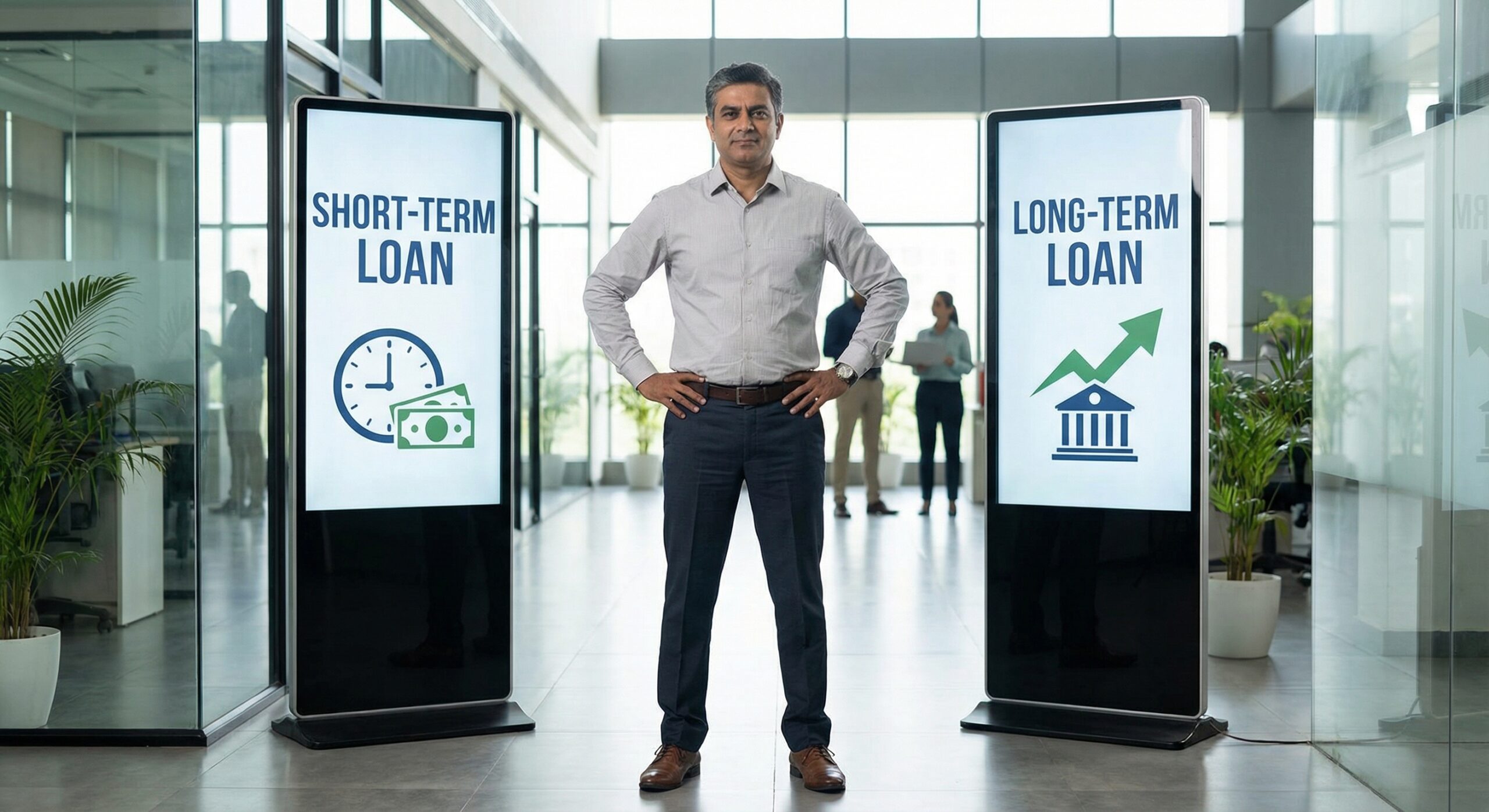
The Decision Every Business Owner Eventually Faces…
Every growing business hits that moment:
“Do I take a short-term loan and move fast, or pick a long-term loan and play it safe?”
It’s not a small decision.
It can shape your cash flow, expansion speed, and even your peace of mind.
The challenge?
Most SMEs don’t fully understand the difference — and end up choosing loans based on urgency rather than strategy.
At Sunrays Finance, we’ve worked with thousands of small businesses, and one thing is clear:
The right loan isn’t the cheapest loan — it’s the loan that aligns with your business cycle.
Let’s break it down simply, without the jargon and banker-speak.
1. What Is a Short-Term Business Loan?
A short-term loan typically runs from 3 months to 18 months, and is designed for quick financial needs.
When do businesses actually need it?
When payments from clients get delayed
When you want to purchase inventory for a seasonal spike
When a big order suddenly comes in
When you need working capital TODAY, not after 20 days of approvals
When you’re waiting for invoices to clear
Short-term loans move quickly because the lender understands that opportunity doesn’t wait.
Key Features
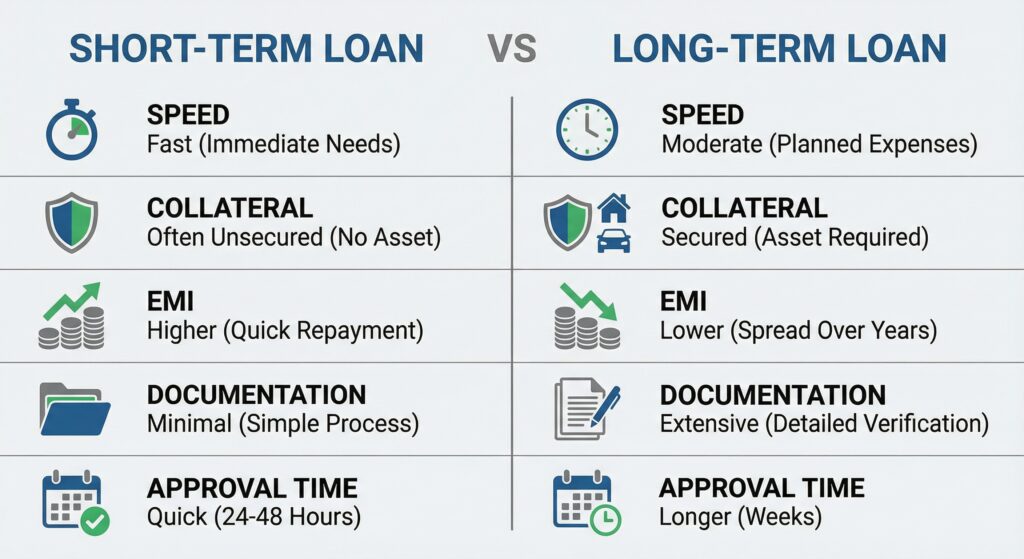
Tenure: 3 to 18 months
Processing time: Very fast
Collateral: Usually not required
EMI size: Higher (due to shorter duration)
Used for: Cash flow gaps, inventory, machinery repair, quick expansion
If your business relies heavily on speed — FMCG, distribution, textiles, logistics, trading — this type of loan can literally save your month.
2. What Is a Long-Term Business Loan?
A long-term loan usually stretches from 2 years to 7 years.
Think of it as a “big vision” loan — for businesses that want to scale, upgrade, build, or expand.
When businesses need long-term loans
Opening a new branch
Buying large machinery
Expanding warehouse or factory capacity
Purchasing commercial vehicles
Building long-term infrastructure
Long-term loans come with lower EMIs because the repayment is spread over years — but the catch is slower approval and more paperwork.
Key Features
Tenure: 2 to 7 years
Processing: Slower (banks/NBFCs)
Collateral: Usually required
EMI size: Lower
Used for: Heavy expansion, machinery, vehicles, real estate
3. Short-Term vs Long-Term Loans — A Simple Comparison
Short-Term Loan
Speed: 🔥 Fast
Collateral: ❌ No
Purpose: Cash flow, seasonal demand
EMI: High
Approval: Quick
Flexibility: High
Long-Term Loan
Speed: 🐢 Slow
Collateral: ✔ Yes
Purpose: Expansion, assets
EMI: Low
Approval: Detailed
Flexibility: Medium
But here’s the truth:
Most SMEs don’t actually need one or the other — they need the right one based on their business timing.
Which brings us to…
4. How to Choose the Right Loan for YOUR Business
A. Check Your Cash Flow Stability
If your income is fluctuating, opt for a short-term loan.
If your income is steady, you can comfortably manage a long-term EMI.
B. Understand Your Business Cycles
Every business has a rhythm:
Garments: Seasonal peaks
FMCG: Consistent but cycle-based
Construction: Payment-driven
Logistics: Contract-based
Match your loan tenure with your money cycle — not with what the bank offers.
C. How urgent is the money?
If you need funds within 48–72 hours, long-term loans will delay your opportunity.
Short-term private financing wins here.
D. Do you want flexibility?
Short-term loans usually offer:
Minimal paperwork
No collateral
Faster repayment cycles
No property evaluation
Simple renewal
For SMEs, that flexibility is priceless.
5. Real Scenarios From the Ground (Anonymous Case Studies)
Case Study 1: The Textile Retailer (Chennai)
Ramesh gets bulk wedding orders in November–December.
He needs fast inventory.
Banks say:
“Submit audited balance sheets.”
“Provide property documents.”
“Wait 12 working days.”
He loses the order.
With a short-term cheque-based loan, he gets funds in 36 hours, buys stock, and makes a 40% profit.
Lesson: Seasonal businesses = SHORT TERM.
Case Study 2: The Auto Components Manufacturer (Coimbatore)
Needs a new CNC machine worth ₹35 lakh.
Short-term loan EMI would kill his cash flow.
Long-term EMI spreads it out → business grows steadily.
Lesson: Long-term assets = LONG TERM.
Case Study 3: The Distributor (Trichy)
Client payments come every 45 days but distributors need to pay suppliers every 7 days.
Cash flow mismatch ruins credit scores and supplier relationships.
A rolling short-term finance cycle fixes everything.
Lesson: Payment delays = SHORT TERM.
6. Mistakes Businesses Make While Choosing Loan Types
❌ Mistake 1: Choosing based on interest rate alone
A lower rate doesn’t help if approval takes 20 days and you lose the opportunity.
❌ Mistake 2: Not matching EMI cycle with business cycle
Your loan should breathe with your business.
❌ Mistake 3: Taking a long-term loan for short-term needs
You end up paying unnecessarily for years.
❌ Mistake 4: Using collateral for unsafe short-term needs
Never put your house or land at risk for inventory.
7. What Sunrays Finance Recommends
We’ve studied thousands of SME cases, and the formula is simple:
Choose a short-term loan when you need:
Speed
Flexibility
Zero collateral
Quick opportunity
Inventory support
Cash flow gap coverage
Choose a long-term loan when you need:
Stability
Asset creation
Lower EMI
Capacity expansion
Infrastructure building
Always choose the loan that supports your growth — not your stress.

8. Final Thought
Short-term and long-term loans aren’t competitors.
They’re tools.
Used correctly, they can:
Strengthen your business
Expand your opportunities
Build your future
Used wrongly, they can drain your cash flow and increase pressure.
At Sunrays Finance, our job is simple:
Help SMEs choose the right financial path — fast, fair, and without complications.
If you ever need short-term, collateral-free finance to grab an opportunity, expand quickly, or cover a cash crunch — we’re here.
📞 Call 7200005385
🌐 sunraysfinance.com