

Many business owners assume that if sales are growing, the business is moving in the right direction.
And while revenue is important, it doesn’t always tell the full story.
Across industries, many SMEs generate healthy sales, maintain strong customer relationships, and continue attracting new opportunities. Yet despite all of this, growth often feels slower than expected.
The reason is frequently not a lack of demand.
It is poor working capital management.
Unlike major business problems, working capital mistakes rarely announce themselves. They develop quietly over time, affecting cash flow, inventory, supplier relationships, and growth opportunities.
Let’s look at some of the most common working capital mistakes that can slow down even good businesses.
Mistake #1: Focusing Only on Revenue
Many business owners closely monitor sales numbers but pay less attention to cash flow.
A business may generate strong revenue and still experience liquidity pressure if customer payments are delayed.
This often creates a false sense of financial confidence.
Growth becomes difficult when cash is unavailable to support daily operations, regardless of what the sales reports show.
Successful businesses monitor both revenue and cash flow together.
Mistake #2: Allowing Receivables to Grow Unchecked
Customer credit is a normal part of many industries.
However, when outstanding receivables begin to grow without proper follow-up, working capital can become strained.
Businesses often discover that a large percentage of their cash is sitting in unpaid invoices.
Regular collection reviews and clear payment processes can significantly improve liquidity.
Cash collected on time creates flexibility.
Cash delayed creates pressure.
Mistake #3: Overstocking Inventory
Inventory supports growth.
But excessive inventory can quietly consume working capital.
Many businesses purchase more stock than necessary because of:
- Demand assumptions
- Bulk purchase discounts
- Fear of stock shortages
The result is that cash becomes locked inside inventory rather than remaining available for operations.
Strong inventory planning helps businesses maintain the right balance between availability and liquidity.
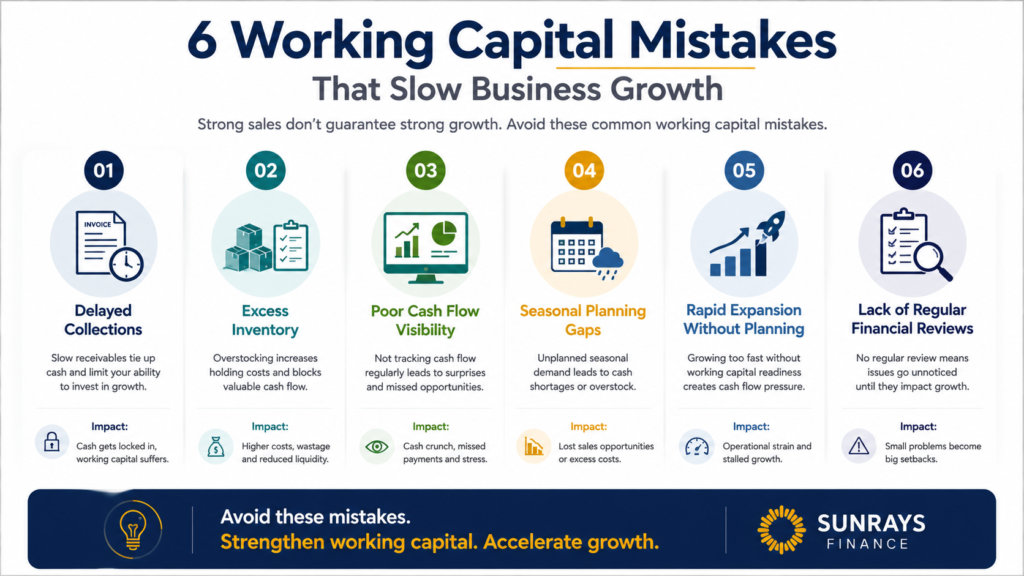
Mistake #4: Ignoring Seasonal Cash Flow Patterns
Most businesses experience seasonal fluctuations.
Some periods generate strong sales.
Others may be slower.
Businesses that fail to anticipate these cycles often experience unnecessary cash flow stress.
Understanding seasonal trends helps business owners:
- Prepare inventory levels
- Manage expenses
- Plan working capital requirements
Preparation reduces surprises.
Mistake #5: Expanding Too Quickly
Growth is exciting.
But expansion often requires significant financial support.
Opening a new branch, increasing production, or entering a new market usually creates higher expenses before additional revenue arrives.
Without proper working capital planning, expansion can place pressure on existing operations.
The most successful businesses grow with preparation rather than urgency.
Mistake #6: Delaying Financial Reviews
Many SMEs review financial performance only when problems appear.
By then, corrective action may become more difficult.
Regular reviews of:
- Cash flow
- Receivables
- Inventory levels
- Operating expenses
can help identify potential issues early.
Early awareness allows businesses to make better decisions.
Why These Mistakes Matter
Individually, each of these mistakes may seem minor.
However, over time they can lead to:
- Reduced liquidity
- Delayed supplier payments
- Missed opportunities
- Slower growth
- Increased operational stress
The impact is often gradual, which makes these issues easy to overlook.
Yet they can significantly influence long-term business performance.
What Successful Businesses Do Differently
Businesses that manage working capital effectively often follow a few simple habits:
- Monitor cash flow regularly
- Track receivables closely
- Review inventory levels consistently
- Forecast seasonal requirements
- Plan funding needs before they become urgent
These practices help maintain financial stability while supporting growth.

Where Sunrays Finance Fits In
At Sunrays Finance, we understand that working capital plays a critical role in day-to-day business operations.
Whether businesses require support for inventory funding, seasonal demand, receivable gaps, or short-term liquidity needs, the objective is to help them maintain momentum while managing cash flow more effectively.
Because healthy working capital often creates the foundation for sustainable growth.
Final Thought
Most businesses are not slowed down by one major mistake.
They are slowed down by small financial inefficiencies that accumulate over time.
Working capital may operate quietly in the background, but it influences almost every aspect of business performance.
The businesses that grow consistently are often the ones that pay attention to these details before they become problems.
Because in business, strong working capital management is not just about stability.
It is about creating the ability to grow with confidence.