

Running a business often requires making decisions that balance opportunity with responsibility. One of the most important decisions a business owner will face is whether to take a loan.
In today’s competitive business environment, access to finance can help companies expand, manage working capital, purchase inventory, upgrade equipment, or seize growth opportunities. However, successful businesses understand that taking a loan is not just about getting access to money—it’s about making sure that money supports long-term business goals without creating unnecessary financial pressure.
The smartest business owners don’t ask, “Can I get a loan?” They ask, “Is this the right loan for my business, and can it help me grow sustainably?”
Before signing any loan agreement, there are several critical factors every business owner should evaluate.
Why Taking a Loan Should Be a Strategic Decision
Many businesses only think about financing when they face a cash shortage. By the time they begin searching for funding, the business may already be under pressure from delayed payments, inventory shortages, or missed opportunities.
Successful entrepreneurs view financing differently.
They see funding as a business tool that can:
- Support growth
- Improve cash flow
- Help manage seasonal demand
- Fund expansion opportunities
- Strengthen business operations
When used correctly, financing can accelerate growth. When used without planning, it can create additional stress.
This is why every loan decision should begin with a clear business objective.
Start With One Important Question: Why Do You Need the Loan?
Before comparing lenders, interest rates, or repayment terms, define the exact purpose of the loan.
Common business funding needs include:
Working Capital Management
Many businesses experience temporary gaps between outgoing expenses and incoming payments. Working capital funding can help bridge these short-term gaps.
Inventory Purchase
Retailers, traders, manufacturers, and distributors often require additional funds to stock inventory before peak demand periods.
Business Expansion
Opening a new branch, entering a new market, or increasing production capacity often requires additional capital.
Equipment or Machinery Upgrades
Investing in better equipment can improve efficiency and increase profitability over time.
Managing Delayed Receivables
Businesses that regularly wait 30, 60, or even 90 days for customer payments may require short-term funding support.
The clearer the purpose, the easier it becomes to select the right financing solution.
Understand Your Cash Flow Before Borrowing
One of the biggest mistakes business owners make is focusing only on revenue and profit.
Revenue does not equal cash flow.
A business may generate strong sales and still struggle to repay a loan if money is tied up in inventory or delayed customer payments.
Before taking any loan, review:
- Monthly cash inflows
- Monthly operating expenses
- Existing debt obligations
- Customer payment cycles
- Supplier payment schedules
Understanding cash flow helps determine whether the business can comfortably handle repayments.
Businesses that borrow without understanding their cash flow often face unnecessary financial pressure later.
Can Your Business Comfortably Repay the Loan?
Just because a lender approves a loan doesn’t mean it is the right amount for your business.
There is a significant difference between:
Loan Eligibility and Loan Affordability
A lender may approve a larger amount based on available data, but business owners should focus on what the business can realistically repay.
Ask yourself:
- Will repayments affect daily operations?
- Can the business handle repayments during slow months?
- What happens if customer payments are delayed?
- Is there sufficient cash reserve for unexpected expenses?
The goal is not to borrow the maximum amount available.
The goal is to borrow the amount that supports growth while maintaining financial stability.
Look Beyond the Interest Rate
Many borrowers focus only on the interest rate when comparing financing options.
While interest rates are important, they are not the complete picture.
Business owners should also evaluate:
- Processing fees
- Documentation charges
- Foreclosure penalties
- Late payment penalties
- Loan tenure
- Repayment structure
Sometimes a loan with a slightly higher rate but more flexible terms may be a better fit than a lower-rate option with restrictive conditions.
Always evaluate the total cost of borrowing, not just the advertised rate.
Choose the Right Type of Financing
Different business needs require different financing solutions.
A common mistake is using the same funding structure for every situation.
Short-Term Finance
Best suited for:
- Working capital needs
- Inventory purchases
- Temporary cash flow gaps
Expansion Funding
Suitable for:
- Opening new branches
- Capacity expansion
- Business growth initiatives
Invoice-Based Funding
Useful when:
- Customer payments are delayed
- Receivables are locked for extended periods
Equipment Finance
Ideal for:
- Machinery purchases
- Technology upgrades
- Productivity improvements
Selecting the right funding structure can significantly improve financial efficiency.
Timing Matters More Than Most Businesses Realise
Many business owners seek funding only after an opportunity appears.
By then, it may already be too late.
Smart businesses prepare funding plans before:
- Festival seasons
- Expansion projects
- Large purchase orders
- Inventory stocking periods
Consider a textile trader preparing for festive demand.
If funding is arranged early:
- Inventory can be secured at better prices
- Operations remain smooth
- Growth opportunities can be captured
If funding is arranged late:
- Inventory costs may increase
- Opportunities may be missed
- Business stress rises
In many situations, timing has a greater impact than small differences in interest rates.
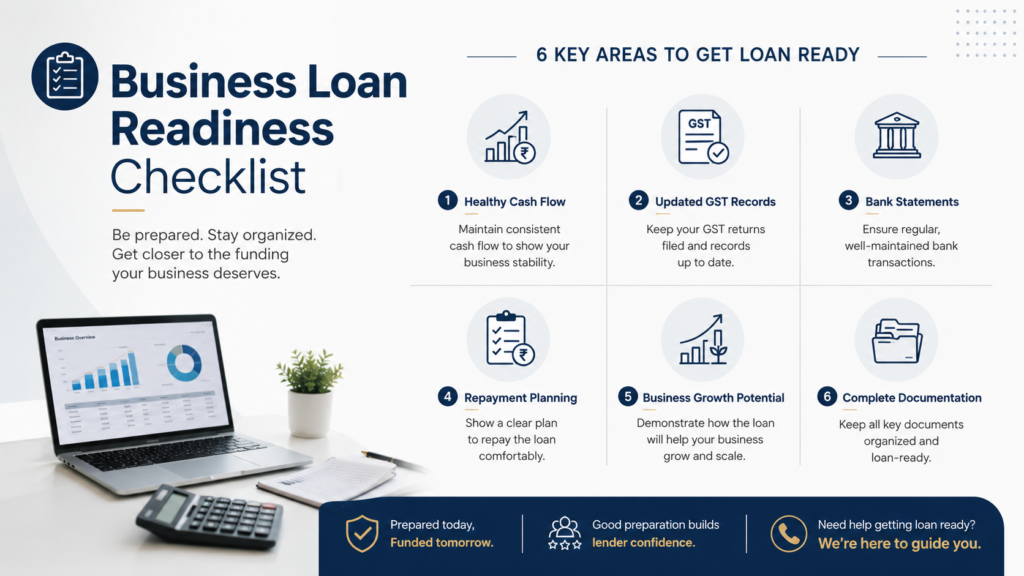
Keep Your Financial Records Clean
One of the strongest indicators of business discipline is financial documentation.
Lenders, investors, and financial partners prefer businesses that maintain organized records.
Important documents typically include:
- GST filings
- Bank statements
- Business registration details
- Financial statements
- Income records
- Existing loan information
Clean documentation often leads to:
- Faster approvals
- Better funding options
- Improved credibility
Good records are not just useful for financing—they strengthen the business itself.
Common Borrowing Mistakes SMEs Should Avoid
Even experienced business owners occasionally make financing mistakes.
Some of the most common include:
Borrowing Without a Clear Purpose
Taking a loan simply because funds are available can create unnecessary debt.
Borrowing Too Late
Waiting until cash flow becomes critical reduces options and increases stress.
Ignoring Cash Flow
Strong sales do not guarantee repayment capacity.
Borrowing More Than Necessary
Excess borrowing increases interest costs and repayment pressure.
Using Short-Term Finance for Long-Term Projects
Mismatch between funding structure and business need can create ongoing liquidity challenges.
Avoiding these mistakes can significantly improve financial outcomes.
A Simple Smart Borrowing Checklist
Before taking any business loan, review this checklist:
✔ Purpose of funding is clearly defined
✔ Business cash flow is understood
✔ Repayment capacity is realistic
✔ Loan type matches business requirement
✔ Documentation is up to date
✔ Total borrowing cost has been evaluated
✔ Funding timing supports business goals
✔ Business can absorb unexpected disruptions
If all boxes are checked, the financing decision is likely built on a strong foundation.

Where Sunrays Finance Fits In
At Sunrays Finance, we understand that every business faces different challenges and opportunities.
Some businesses need short-term working capital support.
Others need funding to seize growth opportunities, manage receivables, or prepare for seasonal demand.
Rather than focusing only on loan amounts, the objective is to help businesses identify financing solutions that align with their cash flow, business cycle, and long-term goals.
The right funding at the right time can help businesses move forward with confidence.
Final Thought
Taking a loan should never be an emotional decision or a reaction to panic.
It should be a strategic step that supports growth, strengthens operations, and improves business resilience.
The smartest business owners do not take loans simply because money is available.
They take loans because the purpose is clear, the timing is right, and the repayment plan makes business sense.
In business, smart borrowing is not about accessing capital.
It is about using capital wisely.