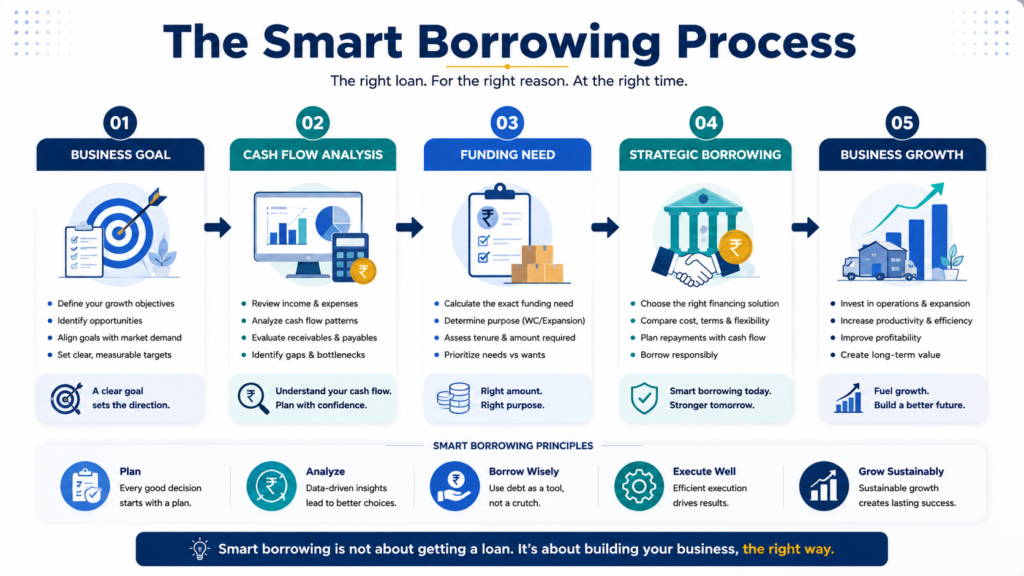
The way businesses think about finance is changing.
A decade ago, many business owners viewed borrowing as something they turned to only during emergencies. Funding was often seen as a last resort when cash flow became tight or unexpected expenses appeared.
Today, that mindset is evolving.
Many SMEs are beginning to see finance not as a backup plan, but as a strategic tool that can support growth, improve efficiency, and create new opportunities.
This shift has given rise to what many experts call smart borrowing—using finance intentionally to strengthen the business rather than simply solve short-term problems.
Borrowing Has Become More Strategic
Modern business owners understand that growth often requires investment before results appear.
Whether it’s expanding inventory, increasing production capacity, entering a new market, or upgrading operations, growth usually involves upfront costs.
Rather than waiting for cash shortages to appear, many SMEs are planning their financing requirements in advance.
This proactive approach allows businesses to make decisions based on opportunity rather than urgency.
Smart Borrowing Starts With a Clear Purpose
One of the biggest differences between strategic borrowing and reactive borrowing is clarity.
Successful SMEs typically know exactly why they need funding.
Common objectives include:
Managing working capital
Purchasing inventory
Expanding operations
Supporting seasonal demand
Upgrading equipment
Improving business efficiency
When the purpose is clearly defined, businesses are more likely to choose financing solutions that support long-term goals.
Timing Plays a Critical Role
Many business opportunities have limited windows.
A new customer contract, a seasonal sales period, or a supplier discount may require quick action.
Businesses that secure funding before the opportunity arrives are often better positioned to act with confidence.
This is one reason many growing SMEs now view financial planning as an ongoing process rather than a one-time activity.
The right funding at the right time can create far greater value than waiting until cash flow pressure becomes urgent.
Cash Flow Awareness Is Improving
Today’s SMEs have better access to financial information than ever before.
Many businesses actively track:
Receivables
Inventory levels
Monthly expenses
Business forecasts
Cash flow trends
This visibility helps business owners identify funding needs early and make more informed decisions.
Instead of reacting to shortages, businesses can prepare for them.
Smart Borrowing Is Not About Borrowing More
A common misconception is that strategic finance means taking larger loans.
In reality, smart borrowing is often about borrowing responsibly.
Successful businesses focus on:
Matching funding to business needs
Avoiding unnecessary debt
Maintaining healthy repayment capacity
Choosing appropriate financing structures
The goal is not simply to access capital.
The goal is to use capital efficiently.
How SMEs Are Using Finance in 2026
Across South India and the broader Indian market, SMEs are increasingly using finance to:
Support growth initiatives
Improve inventory management
Maintain operational continuity
Manage seasonal business cycles
Respond quickly to market opportunities
Businesses are becoming more comfortable using finance as part of their overall growth strategy rather than viewing it purely as a solution during difficult periods.
Common Traits of Financially Prepared Businesses
Businesses that use finance effectively often share similar habits:
Regular cash flow monitoring
Forward planning
Strong financial discipline
Clear growth objectives
Better documentation and record-keeping
These practices allow them to make faster and more confident business decisions.
Where Sunrays Finance Fits In
At Sunrays Finance, we work with businesses that want to use finance strategically.
Whether the requirement involves working capital, inventory funding, expansion planning, or managing temporary liquidity gaps, the objective is to support business growth while maintaining financial stability.
Every business has unique goals and cash flow cycles. The right funding solution should align with those realities rather than create additional pressure.
Final Thought
The conversation around business finance is changing.
Today’s most successful SMEs are not waiting until problems arise before exploring funding options.
They are planning ahead, monitoring cash flow, and using finance as a tool to support growth.
Smart borrowing is not about taking more debt.
It is about making better decisions.
Businesses that understand this difference are often better positioned to grow, adapt, and seize opportunities in an increasingly competitive market.
Because in modern business, access to capital matters—but knowing how to use it matters even more.