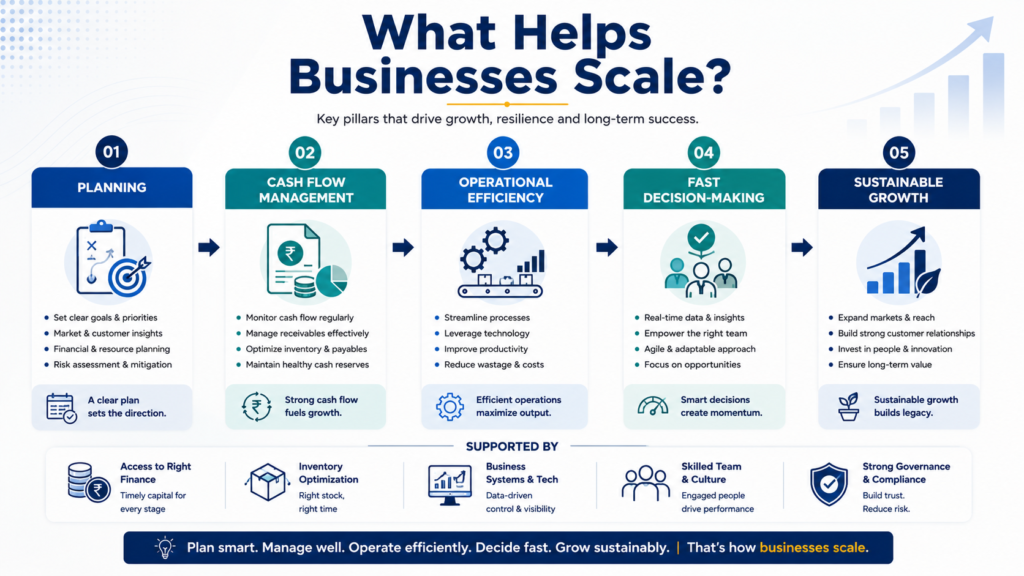
More customers, larger orders, stronger revenue, and greater market presence are goals shared by businesses across every industry.
Yet when we look at the market, an interesting pattern emerges.
Some businesses seem to scale steadily year after year, while others remain stuck despite having similar products, similar customers, and even similar opportunities.
The difference is rarely luck.
More often, it comes down to preparation, decision-making, and the ability to manage growth effectively.
Understanding these differences can help businesses identify what may be holding them back and what they can do to move forward.
Growth Requires More Than Demand
Many business owners believe that growth is primarily driven by sales.
While demand is important, growth depends on much more than attracting customers.
As businesses expand, they face new challenges:
Managing cash flow
Hiring and retaining talent
Handling larger order volumes
Improving operational efficiency
Maintaining customer satisfaction
Businesses that prepare for these challenges tend to scale more smoothly.
Those that focus only on sales often struggle when growth begins to accelerate.
The Importance of Planning Ahead
One common trait among growing businesses is proactive planning.
Successful business owners regularly ask:
What will happen if orders increase next month?
Do we have enough inventory?
Can our team handle additional demand?
Is our working capital sufficient?
Businesses that think ahead are usually better prepared when opportunities arise.
Those that wait until problems appear often find themselves reacting under pressure.
Cash Flow Often Determines Growth
Many businesses with strong sales still face growth challenges.
The reason is simple:
Revenue and cash flow are not the same.
A business may generate large orders but still struggle if customer payments take time to arrive.
At the same time, expenses such as inventory, salaries, logistics, and supplier payments continue.
Businesses that monitor cash flow carefully are often able to expand with greater confidence because they understand the financial impact of growth before it happens.
Operational Efficiency Matters
Growth creates complexity.
Processes that work for a small business may not work once order volumes increase.
Businesses that scale successfully often invest in:
Better systems
Inventory management
Process improvements
Financial tracking
Team development
These improvements help maintain consistency as the business grows.
Without operational discipline, growth can quickly become difficult to manage.
Decision-Making Speed Creates Advantage
Opportunities rarely wait.
A new customer, a large purchase order, or a market expansion opportunity often requires quick action.
Businesses that can make informed decisions quickly tend to gain a competitive edge.
This does not mean making rushed decisions.
It means having the information, systems, and financial readiness required to act when opportunities appear.
Common Reasons Businesses Stay Stuck
Many businesses remain stagnant because they repeatedly face the same challenges:
Delayed decision-making
Poor cash flow planning
Lack of growth strategy
Overdependence on a few customers
Insufficient operational systems
Fear of calculated expansion
Over time, these issues can limit growth even when market demand exists.
What Successful Businesses Do Differently
Businesses that scale smoothly often share several characteristics:
They monitor financial performance regularly
They forecast cash flow instead of reacting to shortages
They invest in systems and efficiency
They prepare for growth before it arrives
They treat finance as a strategic tool
Most importantly, they view growth as a process that requires planning—not just ambition.
Where Sunrays Finance Fits In
At Sunrays Finance, we work with businesses that are preparing for their next stage of growth.
Whether the requirement involves working capital, expansion planning, inventory funding, or managing temporary liquidity gaps, the objective is to support business momentum without creating unnecessary financial pressure.
Growth opportunities are valuable when businesses have the resources and confidence to act on them.
Final Thought
The difference between businesses that scale and businesses that stay stuck is rarely a single decision.
It is often the result of many small decisions made consistently over time.
Growth requires preparation, financial discipline, operational efficiency, and the ability to act when opportunities appear.
Businesses that focus on these fundamentals are often better positioned to grow sustainably and confidently.
Because in business, growth is not just about moving faster.